

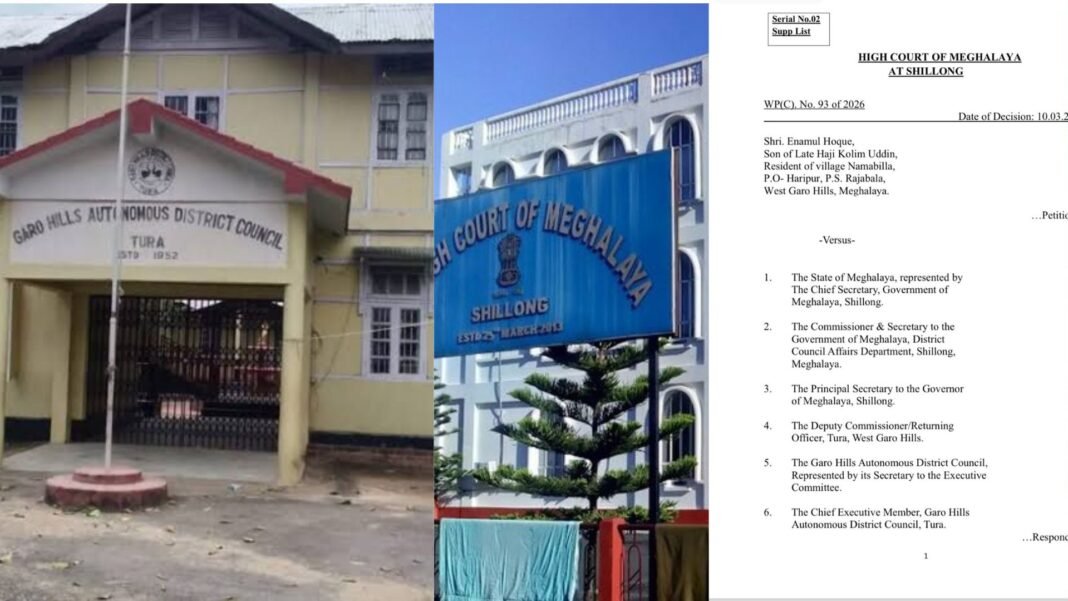

Shillong: The Meghalaya High Court on Tuesday set aside a notification issued by the Garo Hills Autonomous District Council (GHADC) that made possession of a Scheduled Tribe (ST) certificate mandatory for candidates contesting the council elections, ruling that the order was issued without following the legally required legislative process.
The bench headed by Justice H.S. Thangkhiew delivered the order while hearing a petition filed by Enamul Hoque, who challenged the February 17 notification issued by the Chief Executive Member of the GHADC.
In its judgment, the court held that the Executive Committee had acted beyond its powers by issuing the notification without placing the matter before the District Council and without obtaining the approval of the Governor as required under the rules governing district councils.
“It is noted that since 1952 non-tribals have featured and are present” in GHADC’s list of elected members, the bench observed, pointing out that the existing legal framework has historically allowed non-tribals to contest and hold seats in the council.
The court further noted that the impugned notification lacked the necessary procedural backing required for it to have the force of law.
“The duty of the Court at this juncture is only to examine as to whether this exercise is legislatively competent.”
Explaining the legal framework, the bench stated that the notification was issued on the basis of a resolution passed by the Executive Committee and purportedly derived from powers under Paragraph 2 of the Sixth Schedule of the Constitution.
“The impugned notification, as noted earlier was notified in pursuance to a resolution of the Executive Committee and under powers purported to be derived under paragraph 2 of the Sixth Schedule, which is now being sought to be implemented in the upcoming elections. In this context, as arguments have been advanced that the same is in exercise of Rule 29 of the Assam and Meghalaya Autonomous Districts (Constitution of District Councils) Rules, 1951, a perusal of Rule 29 would show that 29 (2) quoted earlier, though giving latitude and power to the Executive Committee to take up matters captioned therein, the same is however subject to the reference to the District Council for final approval.”
The bench pointed out that the notification had been issued directly by the Executive Committee without being placed before the District Council for approval.
“The impugned notification, it is noted has been issued at the level of the Executive Committee itself, without the same being placed before the Council, and further, even if Rule 30 is resorted to, Rule 29 (2) (b) does not envisage the making of Regulations or Rules by the Executive Committee but only for proposals to be made.”
The court also highlighted that any such rule must go through a formal legislative procedure before it can come into effect.
“The impugned notification, apart from other considerations discussed above, to have effect in law would also have to pass the rigours of Rule 72, which provides for the manner in which Rules are to be made by the District Council, which compulsorily require the approval of the Governor, before the same becomes law.”
The bench further noted that under Rule 72, the Executive Committee can only draft proposed rules which must then be placed before the District Council in session and subsequently forwarded through the District Council Affairs Department for the Governor’s assent.
“A perusal of Rule 72, would show that under the Rule making powers of the District Council, the Rules shall be drafted by the Executive Committee and thereafter, be placed before the District Council in session for onward process before the District Council Affairs Department and finally for assent before the Governor.”
According to the court, the February 17 notification had not completed this mandatory process and could therefore be considered only a preliminary step.
“The bench further stated that the notification, in the considered view of this Court, would amount to only the first stage being completed i.e., at most to only a proposal which would necessarily also have to be correspondingly accompanied with proposed amendments to Rule 8 and Rule 128 of the Rules of 1951.”
In its concluding order, the court ruled that the notification could not stand legal scrutiny.
“In view of the above stated facts, circumstances and the interpretation and application of law, the impugned notification therefore, cannot pass legal scrutiny and as such, is accordingly set aside and quashed. The writ petition accordingly is closed and disposed of.”
With the notification now quashed, the existing rules governing eligibility for GHADC elections will continue to apply, allowing non-tribal voters and candidates to participate ahead of the March 16 deadline for filing nominations.