Meghalaya Chief Minister Conrad K. Sangma attended the 65th State-level Teachers’ Day celebration, observed in advance at Tura, and paid tribute to teachers serving across Garo Hills and the State, particularly those working in remote and challenging areas.
The programme also marked the presentation of the State Teachers’ Awards and District Teachers’ Awards 2026, Best Scout Master and Guide Captain Awards, as well as financial assistance under the Teachers’ Welfare Fund.
Congratulating the awardees, Sangma said recognition should extend beyond those receiving awards to teachers serving quietly in remote areas. He particularly referred to teachers running single-teacher schools in border villages “without an audience, without applause,” simply because children depend on them.
Reiterating the importance of teachers, Sangma said, “No education system can rise above the quality of its teachers, however much money we spend on buildings, however many schemes we launch.”
Recalling the situation in 2018, the Chief Minister said an initial plan to transform Meghalaya’s school infrastructure was estimated to require ₹3,000 crore. Despite the financial challenge, he said the government decided to begin with a small number of schools and gradually expand the initiative.
According to the Chief Minister, infrastructure in more than 2,000 elementary government schools has since been upgraded through Mission Education, while the number of Higher Secondary Schools has increased from 427 to 545.
Sangma said education received around ₹150–180 crore from the Chief Minister’s Special Development Fund out of approximately ₹300–400 crore spent during the last eight financial years. Another ₹600–700 crore has been spent through the Education Department, apart from CSR funds directed towards education.
Highlighting the State’s performance in the Performance Grading Index, Sangma said Meghalaya moved from Akanshi-3 to Akanshi-1, with its score rising from 448 to 525.7 out of 1,000. He said the 77.7-point increase was the largest single-year improvement recorded by any state in the country, while Meghalaya registered a cumulative improvement of 124 points, or 31%, over four years.
The Chief Minister also highlighted the State’s 97.2% SSLC pass percentage and 86.6% HSSLC pass percentage, while the transition rate from Class X to XI has increased to 82.1%.
Sangma said the government has developed the Meghalaya School Performance Grading Index (MSPGI) covering all 11,443 schools across 12 districts, assessing them across five domains and 43 indicators. The highest-performing school scored 930 out of 1,000.
East Khasi Hills accounted for 48 of the State’s top 100 schools, followed by Ri Bhoi with 16. Among the Garo Hills districts, West Garo Hills recorded the highest district score of 892, followed by East Garo Hills at 838, South Garo Hills at 808, North Garo Hills at 775 and South-West Garo Hills at 752.
“The MSPGI is not a scoreboard to win or lose, but a map that tells every teacher and school precisely where to direct next year’s effort,” Sangma said.
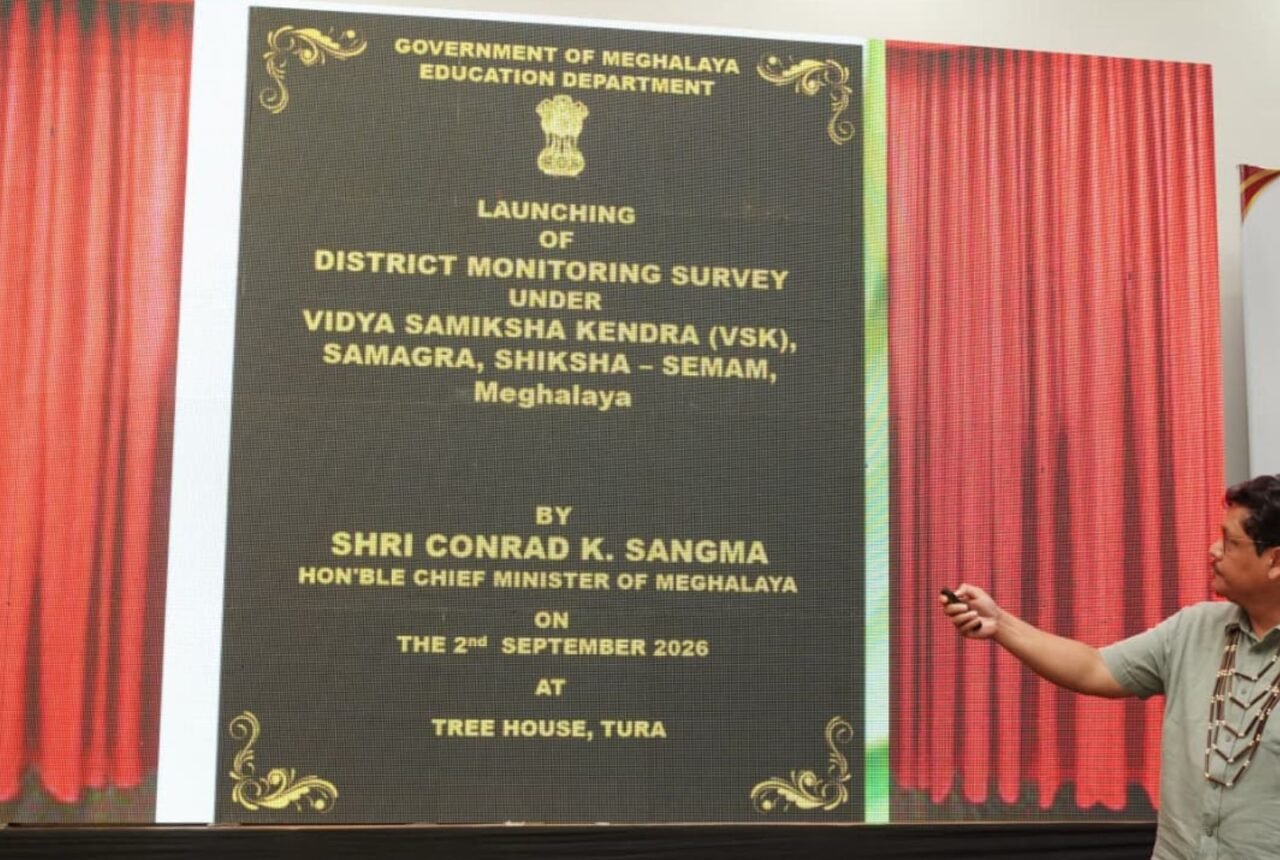
The Chief Minister also directed officials to regularly visit schools and upload observations concerning problems such as leaking roofs, inadequate furniture and drinking water facilities so that senior officials and the Chief Minister can monitor them for corrective action.
Urging teachers to remember the larger purpose of their profession, Sangma said their responsibility goes beyond completing courses and daily routines. “Purpose of every teacher is to shape lives of youth, and while shaping youth, you shape future of country,” he said.
He called upon teachers and officials to work collectively towards transforming Meghalaya’s education sector, adding that every decision should ultimately be guided by one question: “Will it help students?”