

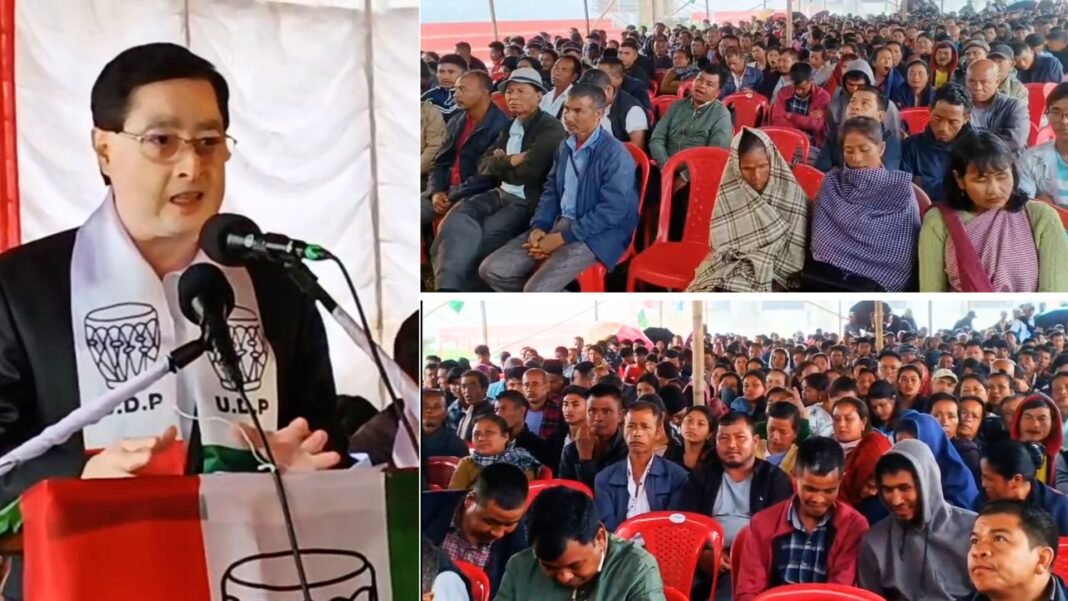

Shillong: United Democratic Party (UDP) Lok Sabha candidate and senior advocate Vivanstone G. Kharngapkynta has alleged that the Meghalaya Government wrongly implemented the Mines and Minerals (Development and Regulation) Act, 1957 (MMDR Act) in the Khasi and Jaintia Hills from 2016 onwards.
Addressing a public meeting at Mawngap on Tuesday, Kynta said the State Government had made a mistake by enforcing the MMDR Act in the region, arguing that the legislation was never applicable to the Khasi-Jaintia Hills. He recalled that during the tenure of Meghalaya’s first Chief Minister, Captain Williamson A. Sangma, a letter from the Union Minister in charge of the Energy Department had assured that the Government of India had no intention of interfering with the customary practices and traditional rights of the indigenous tribal people.
Kynta maintained that the MMDR Act does not apply to the Khasi-Jaintia Hills because Meghalaya is a tribal state governed under the provisions of the Sixth Schedule of the Constitution, which grants special protections to indigenous communities and their traditional institutions.
He further stated that if elected to the Lok Sabha as the UDP candidate, he would work to restore what he described as the people’s rights over mineral resources. According to him, there has been increasing erosion of local ownership rights over minerals despite the Supreme Court’s observation that mineral resources in the Khasi and Jaintia Hills belong to landowners.
Kynta accused the government of introducing various laws that undermine these ownership rights. He also criticized the requirement of possessing up to 100 hectares of land to obtain coal mining permissions, arguing that such provisions effectively favour large outside companies and make it difficult for local landowners to engage in mining activities.
The UDP candidate also pledged to strengthen the powers of the Autonomous District Councils through the Sixth Schedule framework if elected to Parliament. In addition, he said he would advocate for the appointment of a judge from Meghalaya to the Supreme Court, ensuring greater representation of the state at the highest level of the judiciary.